A good content calendar starts with the dates your clients already care about, adds one simple theme for each week, and gets planned a month at a time while the actual posts get drafted a week at a time. That's enough structure to keep you showing up without turning marketing into a second job.
Many advisors try a calendar once, fill in January with great intentions, and stop looking at it by March. That usually has less to do with discipline than with how the calendar was built. A calendar that asks you to invent a fresh idea every morning won't last, while one that hands you the idea and the date will.
Here's how to build one you'll keep, with the dates that matter for the rest of 2026.
What Is a Content Calendar for a Financial Advisor?
A content calendar is a simple plan for what you'll post, where, and when. For an advisor it usually covers social posts, a client email or newsletter, and maybe a blog article, laid out by week.
It can live in a spreadsheet, a paper planner, or a scheduling tool. The format matters far less than the habit of deciding what to say before the week starts, so Monday morning is for reviewing drafts instead of staring at a blank screen.
Why Does a Content Calendar Help Advisors Post More Consistently?
A calendar helps because it removes the hardest decision, which is what to say today. When the topic is already chosen, writing the post takes a fraction of the time.
Consistency is where the payoff shows up. In Kitces Research's 2026 study of how financial planners market their services, 71% of advisors who posted on social media daily won at least one client from it, against 41 to 50% of those posting weekly or monthly. The same study found advisors sending about three newsletters a month won a client from email 33% of the time, compared with 14% for those sending one a month.
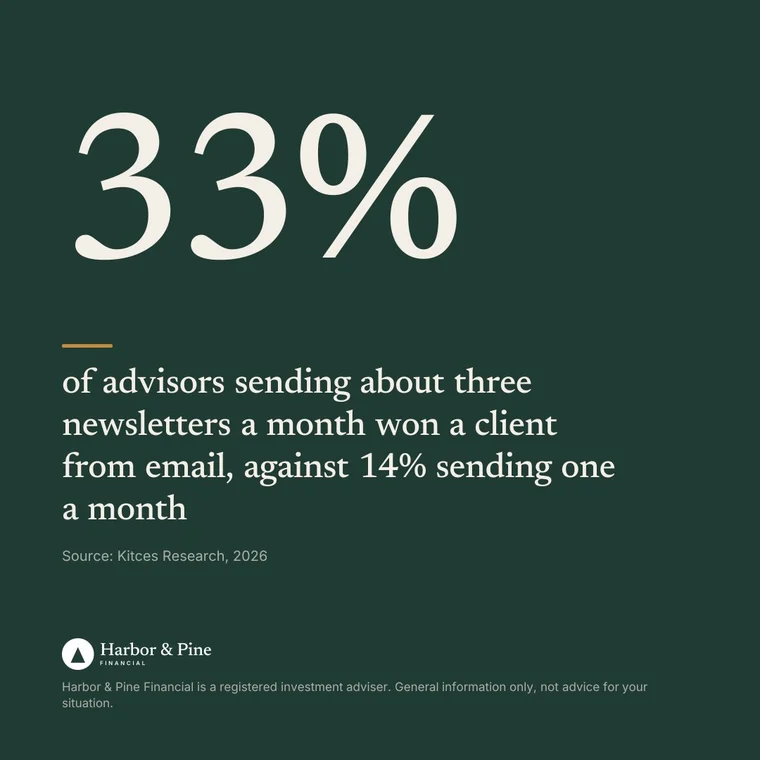
Those numbers describe advisors in the study and can't promise results for any one practice. Still, they point the same direction, and a calendar is the simplest tool for showing up that often. If you're still deciding on a number, the guide on how often financial advisors should post walks through the research.
What Should Go on a Financial Advisor's Content Calendar?
Three kinds of content belong on it, and together they cover most weeks. The first is dates your clients already think about, like tax deadlines, Medicare enrollment, and year-end planning. The second is recurring themes you return to, such as a monthly market check-in or a question you hear in nearly every review meeting. The third is room for whatever happens that week.
The dates do the heavy lifting. A post about Medicare enrollment in mid-October meets people right when they're opening their mail and wondering what to do, which makes it more useful than the same post in June.
The recurring themes give your calendar a rhythm people recognize. If you post a short client question every Tuesday, readers start to expect it, and you never have to wonder what Tuesday's post is about.
Leaving open space matters too. Markets move and rules change, and a calendar packed solid leaves no room to respond when clients are actually worried about something.
Which Dates Belong on Your Q4 2026 Content Calendar?
The fourth quarter is the busiest stretch of the year for useful content, and a handful of dates can anchor the whole quarter.
October is National Financial Planning Month, and CFP Board marks it with resources for CFP professionals to share. The Financial Planning Standards Board holds World Financial Planning Day on October 7, 2026, during the International Organization of Securities Commissions' World Investor Week.
On October 14, the Bureau of Labor Statistics releases September's inflation numbers, and the Social Security Administration typically announces next year's cost-of-living adjustment the same day. Clients on Social Security will hear the number on the news, so a short post explaining what it means for them is easy to plan ahead and fill in that morning.
Medicare open enrollment runs from October 15 to December 7, according to Medicare.gov, with changes taking effect January 1. That's nearly eight weeks of natural reminders for clients who are 65 or caring for parents who are.
December 31 is the deadline for most required minimum distributions, according to the IRS, with the exception of a first RMD, which can wait until April 1 of the following year. A reminder in November and another in early December gives people time to act.
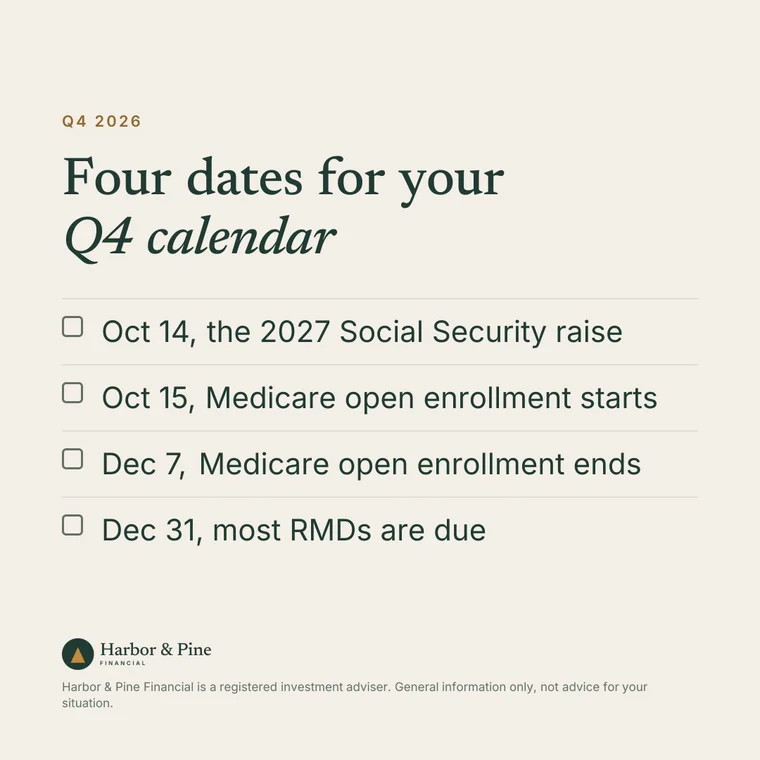
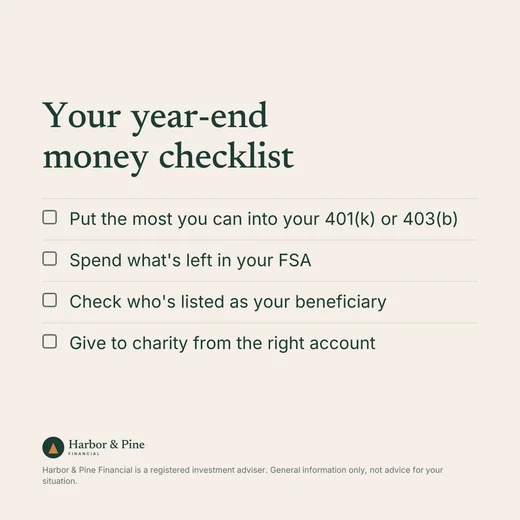
Around those anchors, year-end themes fill in naturally, like charitable giving before December 31, reviewing beneficiaries, and setting goals for the new year.
How Far Ahead Should Financial Advisors Plan Their Content?
Plan the topics a month or a quarter ahead, and draft the actual posts a week at a time. That split keeps you organized without locking you into posts that feel stale by the time they go out.
Here's how I'd think about it. Once a month, sit down for twenty minutes and drop the key dates and weekly themes onto the calendar. Then each week, turn that week's theme into a few angles, like a quick tip, a short story about how you think about it, and a simple graphic with the key number.
Drafting too far ahead has a cost. A post written in September about the Social Security raise can't include the actual number, and a market comment written three weeks early may not match the mood when it goes out.
How Do You Keep a Content Calendar From Falling Apart?
You keep it going by making the weekly drafting take less time than the planning. The calendar itself is rarely the problem. The problem is the hours between the plan and the published post.
Time is already tight. In Morningstar's 2026 Advisor Perspectives Study, advisors said they spend 53% of their workweek on client-focused work and would ideally spend 63%, and 56% named administrative and operational work as the top barrier to serving clients the way they want. Marketing often gets squeezed into whatever is left.
That tracks with what I hear from advisors I work with through Amplify for Advisors. They usually know what to post. Finding the hour to write it, make the graphic, and get it approved is the part that slips.
That's why the drafting is the piece worth handing off. Your judgment, your stories, and your opinions are the parts only you can supply. The first drafts and the graphics are the repetitive parts, and they're the content tasks many advisors hand off first. The drafts still need to sound like you, which is why a voice guide comes before turning up the volume.
Watt, the Amplify for Advisors Agent
See Watt solve this.
Paste your website once, and Watt drafts a week of posts with graphics in your voice and brand, ready for you to approve.
This week · ready for your review



Open now. Watt drafts a week of posts, emails and graphics in your voice, with no client data needed.
Start your 7-day free trialHow Does Compliance Fit Into a Content Calendar?
A calendar makes compliance easier, because review can happen in one batch instead of a scramble before each post. Build the review step into the week from the start.
The rules depend on how you're registered. If you're with a broker-dealer, FINRA Rule 2210 and your firm's own procedures decide which posts need a principal's approval before they go out, so check how your firm treats social media. If you're an RIA, the SEC Marketing Rule applies to your posts, and the books and records rules mean you'll want a copy of each one you publish.
The good news is that a calendar gives your compliance team time. When the month's topics are set and the week's drafts arrive together, they can review them in one sitting, and date-driven posts like the RMD reminder can be approved well before the deadline. The compliance-first approach to AI content walks through how to set that up.
The Bottom Line for Advisors Building a Content Calendar
Start with the dates your clients already care about, give each week one theme, and leave room for the news. Plan the topics a month ahead and draft the posts a week at a time, so the calendar stays useful instead of becoming one more thing to feel behind on.
For the rest of 2026, the anchors are right there. The Social Security announcement on October 14, Medicare enrollment from October 15 to December 7, and the RMD deadline on December 31 can carry a full quarter of posts that your clients will actually want to read.
The calendar works when the next post is already waiting for you.

Sam is the creator of Amplify for Advisors and Watt, the Amplify for Advisors Agent. A former RIA owner whose work has been featured in Forbes, NerdWallet, Nasdaq, and more, he teaches financial advisors to use AI in their own voice while staying compliant.